
RWS Court Cards In Context: Complete Guide For Divinatory Readers
RWS Cards In Context › Court Cards
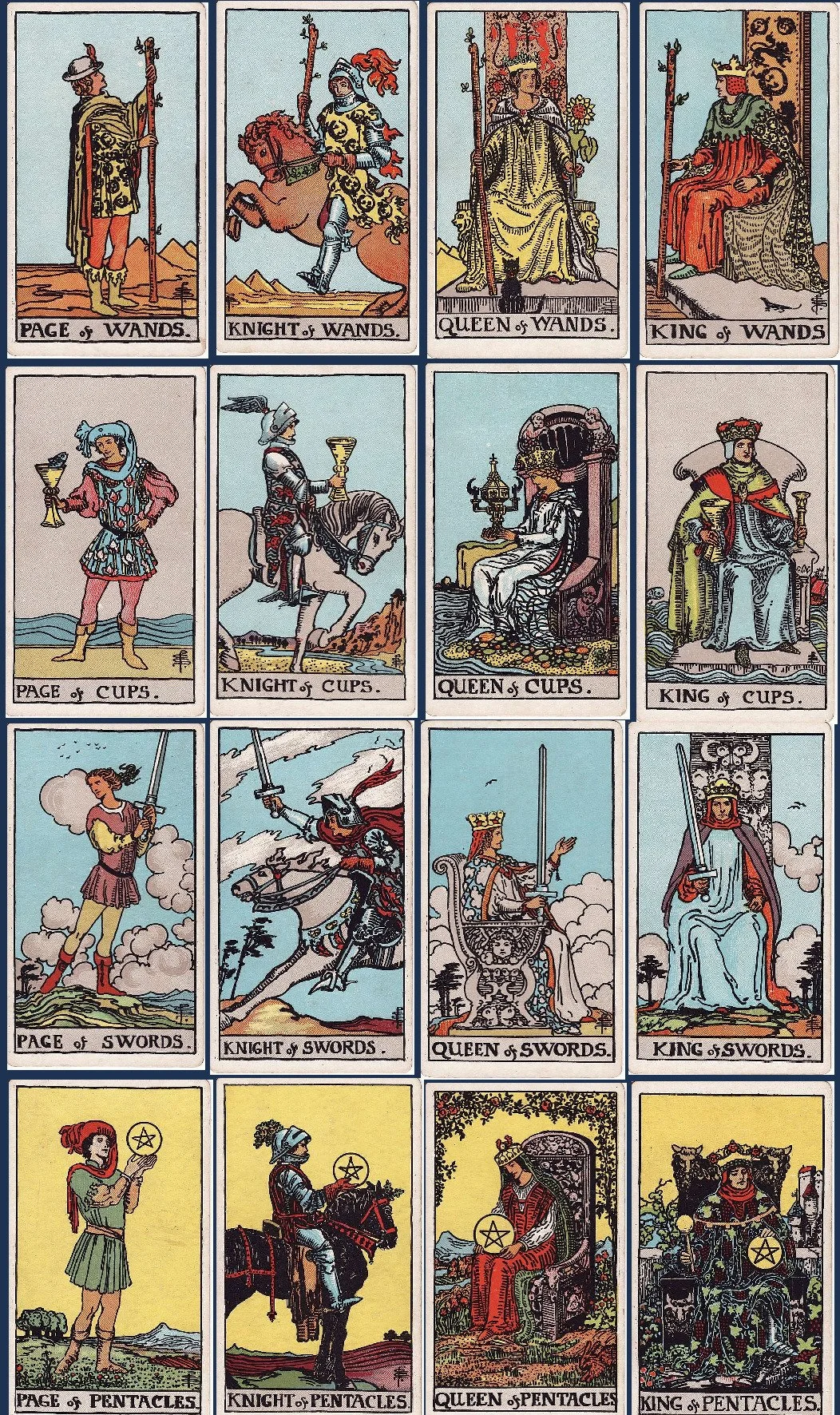
Court Cards Of The RWS Tarot
RWS Court Cards Explained
The 16 Court Cards are the people cards of the Rider Waite Smith (RWS) tarot. They first represent actual people, then personalities and degrees of mastery (Rank) over their respective Suit. Understanding the Court Cards is often the last hurdle in learning tarot tarot card meanings for two reasons.
Confusion over how to distinguish between the 16 personalities
Confusion over how to apply the Court Card meanings in a reading. That is, how to tell whether a Court Card should be interpreted as an external person, internal personality or something else (such as an approach to a situation).
This article gives an overview of the RWS Court Cards by explaining three main methods of interpreting them and providing an overview of each Rank. That solves the first issue just mentioned. The second is solved by a YouTube lesson which will be linked at the end.
Modern RWS Court Card Interpretation
There are three primary layers of Court Card interpretation within the modern use of the RWS system: people, personalities and approaches.
As People (Archetype)
This is the most traditional and direct way to read the court cards. They often represent a specific, literal person in your life or the querent themselves. The Rank suggests their maturity or role while the Suit describes their temperament. When a Court Card appears, ask yourself who in your life fits that description. It can be a charismatic friend (Knight of Wands), a family member (e.g. King of Wands as your Father) or a professional (e.g. Queen of Swords represents solicitors).
As Personality Traits (Element)
More liberally, the Court Cards can be personalities. A reading might show a King of Pentacles not as a rich man, but as the part of the querent that is financially stable and responsible. Or it might be advising you to embody the traits of the card, such as bold courage and frank honesty in the King of Wands.
As Degrees of Mastery (Rank)
Finally for this article, the Ranks of Court Cards can correspond to levels of mastery relative to a situation. The Page of Wands is the spark of a new creative project. The Knight of Wands is the action of pursuing it. The Queen of Wands is the internal confidence and charisma needed for it. The King of Wands is the external command and successful leadership of the project. This Page-to-King progression can show you what stage you are at in developing a skill or handling a situation.
Rank & Suit: The Basic RWS Court Card Formula
Every Court Card is a combination of two factors: its Suit (Element) and it’s Rank (social standing).
The Suit tells you what sort of energies are being expressed by a person (e.g. power and ambition with the Suit of Wands)
The Rank tells you the degree to which this Element has been mastered by a person (e.g. King is external mastery)
To illustrate this, consider the Page of Swords. The Suit of Swords provides the energy of intellect and logic, while the Rank of Page represents a student or messenger. This produces a personality that is inquisitive and mentally alert, especially as regards facts, logic and mathematics. Literally a student (especially of the natural sciences).
What about the Queen of Cups? Here, the Suit of Cups brings an emotional and intuitive focus. When combined with the internal mastery of the Queen, the result is an individual who is deeply empathetic and emotionally self-aware. A painter, psychic, mother or carer.
Finally, the Knight of Wands shows the combination of the Fire element with the action-taking of a determined young male. The result, a passionate, high-speed pursuit of ambitions; someone who embraces the challenges of life. The hobby of combat sports. Or, from a potential female gaze in a love reading; the exciting allure of a ‘bad boy’.
Understanding the Four RWS Court Ranks
To explore the specific meanings of each card, it is possible to navigate via the individual ranks below. Each rank represents a different stage of maturity and a unique way of interacting with the world.
RWS Pages Rank: The Children, Students and Messengers
The Pages are the students and messengers of the court. They represent the initial spark, a new beginning, or the beginner’s mind of their suit. These figures bring news and opportunities while embodying curiosity, inexperience, and the enthusiasm of a new learner. Because they lack the weight of experience, their energy is often light, experimental, and full of potential.
In a practical reading, the Page of Cups might appear when a person is beginning to explore a new creative hobby or a nascent emotional connection. This card suggests that the individual is in the earliest stages of their journey, where they are simply open to the wonder of the experience without worrying about the final outcome. It acts as an invitation to stay emotionally curious and to treat new feelings as messages worth investigating rather than problems to be solved.
RWS Knights Rank: The Young Men & Action-Takers
The Knights are the action-takers of the court. They represent movement, ambition, and a mission-focused energy. Each Knight is fully committed to the quest of their suit, displaying its qualities in a determined and often singular way. Unlike the Pages, who are content to observe and learn, the Knights are driven to prove themselves and to make progress through direct effort.
For example, the Knight of Swords often appears in a reading when a person is charging forward with a new idea or a logical argument. This figure represents the moment one decides to stop planning and start executing. In a professional context, this might manifest as a rapid period of communication or a sharp, decisive movement toward a goal. The card reflects a state of being all in on a specific mission.
RWS Queens Rank: The Women, Mothers & Internal Masters
The Queens are the internal masters of the RWS Court. They represent the mature, internal being and embodiment of their corresponding Element. Their power is magnetic, receptive, and self-aware. Queens influence the world through their presence and wisdom rather than through outward force.
For example, A reading featuring the Queen of Pentacles might suggest a person who has achieved a deep sense of security and practical mastery. This individual does not need to hustle for resources; instead, they provide a stable, nurturing environment for others. In a personal context, this card could represent the ability to manage one's home and finances with a quiet, grounded confidence. In this case, the Queen of Pentacles indicates a level of maturity where one is entirely comfortable with their physical circumstances and their ability to provide.
RWS Kings Rank: Older Men, Authorities & External Mastery
The Kings are the external masters of the court. They represent the mature, external command and authority of their element. Their power is active, directed, and recognised by the world at large. They have mastered their suit and command it to build, lead, and create a lasting legacy. While the Queen masters the element within herself, the King directs that element outward to shape the environment and lead others.
For example, the King of Wands serves as a strong example of this externalised power. In a reading, this card often represents a person who is a natural leader or a visionary entrepreneur. This figure does not just have a passionate idea; they have the authority and the charisma to convince others to follow that vision. As advice, the King of Wands card may appear when a situation requires a person to take charge of something. This might mean using their creative drive to build a business, lead a team, or establish an authority or reputation that is respected in the social hierarchy.
Additional Notes: RWS Court Cards
Waite's Divinatory Court Card Meanings
In A.E. Waite's 1911 The Pictorial Key to the Tarot, his descriptions for the court cards are overwhelmingly as literal people, often with specific physical characteristics. He frequently uses terms like "a dark man," "a fair woman," "a young man," or "a widow."
This shows a strong emphasis on the court cards as external individuals in the querent's life. While he alludes to their qualities (a King of Cups as a "man of business, law, or divinity"), his primary interpretative lens for the court was as the distinct personalities and figures one might encounter in the world.
Note: original meanings of specific RWS Court Cards are given in their respective articles. Please use the Ranks articles to navigate to any of the Court Cards.
Astrological Correspondences
The astrological associations for the 16 court cards are one of the most complex areas of tarot, with two main systems derived from the Golden Dawn. One system assigns an element to each rank: Kings are associated with Fire, Queens with Water, Knights (Princes in GD) with Air, and Pages (Princesses in GD) with Earth.
This is then combined with the suit's element, so the King of Wands is "Fire of Fire," while the Queen of Cups is "Water of Water." The other system, also from the Golden Dawn, assigns the court cards (excluding Pages) to specific 20 or 30-degree segments of the zodiac. For example, the King of Wands rules the last 20 degrees of Pisces and the first 10 of Aries.
Modern systems often simplify this, sometimes linking the ranks to modalities (e.s., Kings as Fixed signs, Queens as Cardinal signs) or just using the Suit's corresponding Element (e.s., all Wands court cards relate to the Fire signs).
Continue Learning: RWS Cards In Context
Enjoyed this article? It is just one part of a full series on the RWS tarot system.
Series Introcution | Suit of Wands | Suit of Cups | Suit of Swords | Suit of Pentacles
