
The Knights: Modern RWS Tarot Card Meanings
Apprenticeship › RWS Meanings › Court Cards › Knights
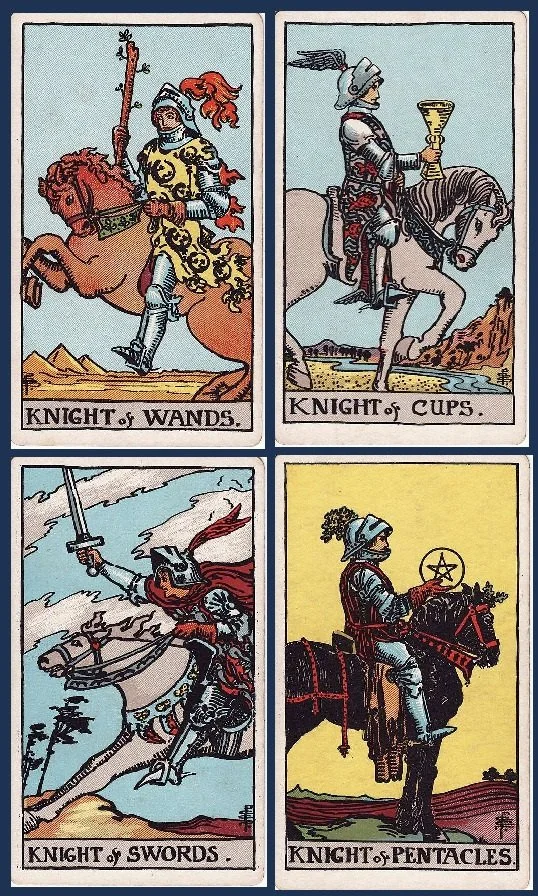
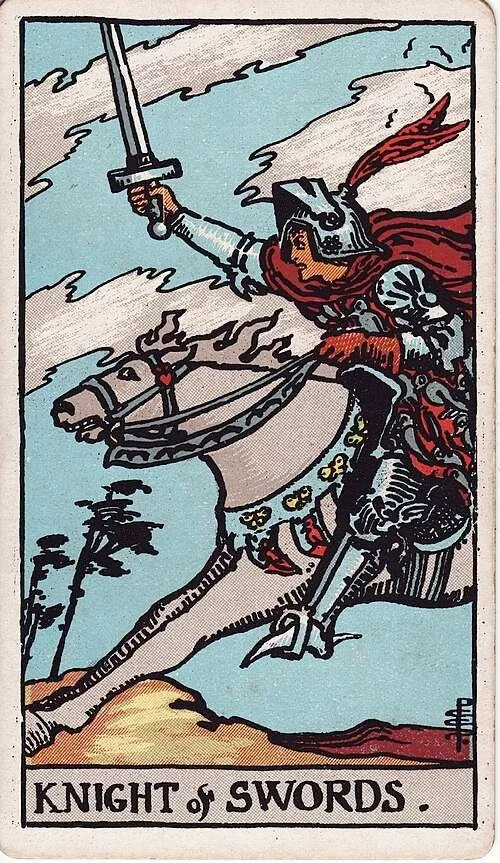
The four Knights of the Rider Waite Smith tarot (1909).
Knights: RWS Court Ranks explained
Knights are the "action-takers" and "doers" of the tarot court. They represent the active, moving, and often extreme expression of their respective element. Where the Pages are the "spark," the Knights are the "action" that follows.
They carry the energy of young adulthood, obsession, and focused pursuit. Historically, they are the young soldiers or equerries on a mission, defined by their quest. Psychologically, they are the single-minded drive to pursue a goal, often with great passion but less of the balanced mastery of the Queens and Kings.
How to Read the RWS Knights in a Tarot Reading
As People (Querent or Others)
When a Knight appears in a reading representing a person, it often points to a young adult or, more importantly, a person of any age who is "all or nothing." They are defined by their mission. This is the person who is passionately pursuing a goal, the romantic partner who sweeps you off your feet, the intellectual who lives for a debate, or the hard worker who is completely dedicated to their routine. Knights can be heroic and admirable, but they can also be extremists. They represent a personality that is less about a balanced state of being and more about a state of "doing," "pursuing," or "acting," for better or worse.
As Situations or Events
As a situation, the Knights represent action, change, and movement. Their appearance signifies that things are happening, and often happening quickly. The Knight of Wands can signal a sudden trip, a fast move, or a project that is rapidly gaining momentum. The Knight of Cups brings romantic invitations, social events, or the arrival of a heartfelt message. The Knight of Swords is the most extreme, often representing a sudden and sharp change, a conflict that appears quickly, or a decision that must be made immediately. The one exception to this speed is the Knight of Pentacles, who represents a slow, deliberate, and methodical process, but a process nonetheless.
As Traits To Embody
When a Knight appears in the advice position, it is almost always a call to act. The time for thinking (Page) is over; it is now time to do. The card advises you to pursue your goal with focus and commitment. The Knight of Wands asks you to be bold, take a risk, and be adventurous. The Knight of Cups encourages you to follow your heart, lead with emotion, and be romantic or compassionate. The Knight of Swords advises you to be assertive, cut through the confusion, and speak your truth directly. The Knight of Pentacles, conversely, advises you to be diligent, stick to the plan, and embrace the routine; his advice is to act by not rushing.
The RWS Knight Rank Meanings By Suit
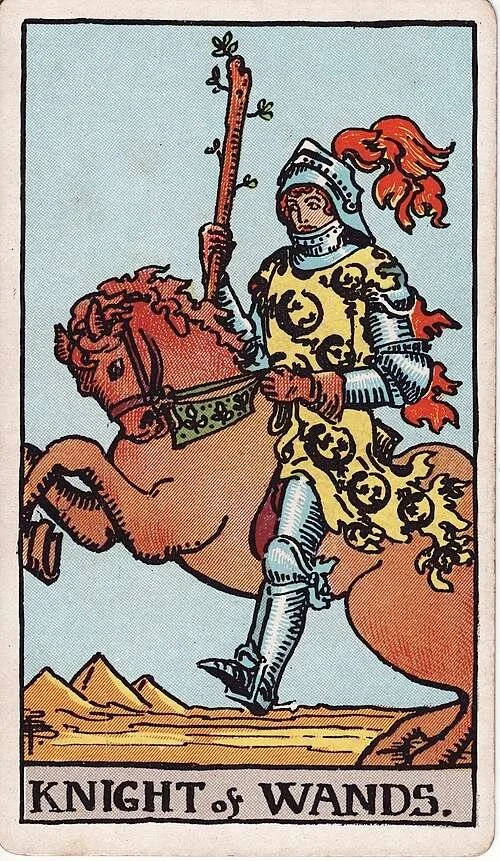
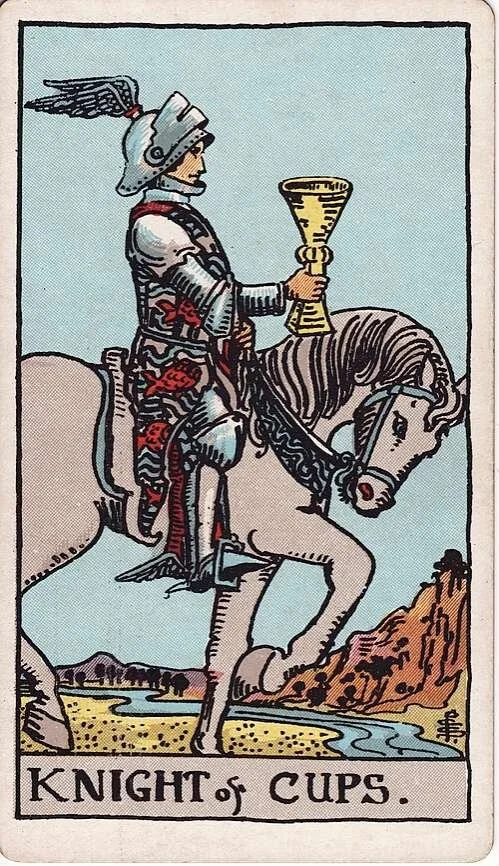
Click on a Knight card to learn about its Rider Waite Smith meanings (upright and reversed) in depth.

Additional Notes: RWS Knights Rank
Waite's Divinatory Knight Rank Meanings
A.E. Waite, in his 1911 text The Pictorial Key to the Tarot, describes the Knights as being in motion and defined by their actions.
For the Knight of Wands, he states: "He is shewn as in motion... departure, absence, flight, emigration."
For the Knight of Cups: "A visit... arrival, approach... message, invitation, proposition." For the
Knight of Swords: "He rides in full course... skill, bravery... capacity... a soldier."
And for the Knight of Pentacles: "He rides a slow, enduring, heavy horse... a useful man... utility, serviceableness."
Collectively, Waite's interpretations cast the Knights as active figures who bring change, arrivals, and departures, with their mode of action defined by their suit.
Astrological Correspondences: Golden Dawn vs Popular-Modern
The astrological associations for the court cards are complex, with two primary systems in use. In the Hermetic Order of the Golden Dawn, from which the RWS deck derives, the Knights were elementally associated with Air. They represented the "airy part" of their suit's element. Thus, the Knight of Wands was "Air of Fire," the Knight of Cups was "Air of Water," the Knight of Swords was "Air of Air," and the Knight of Pentacles was "Air of Earth." This system positions the Knights as the activators and intellectual force behind their element's energy.
A more popular modern system, however, often links the Knights to the four fixed signs of the zodiac, which reflects their single-minded, stubborn focus. In this common modern interpretation, the Knight of Wands is linked to Leo, the Knight of Cups to Scorpio, the Knight of Swords to Aquarius, and the Knight of Pentacles to Taurus. The individual Knights, like the rest of the Tarot Court cards, also have their own astrological correspondences, discussed in their respective articles.
